

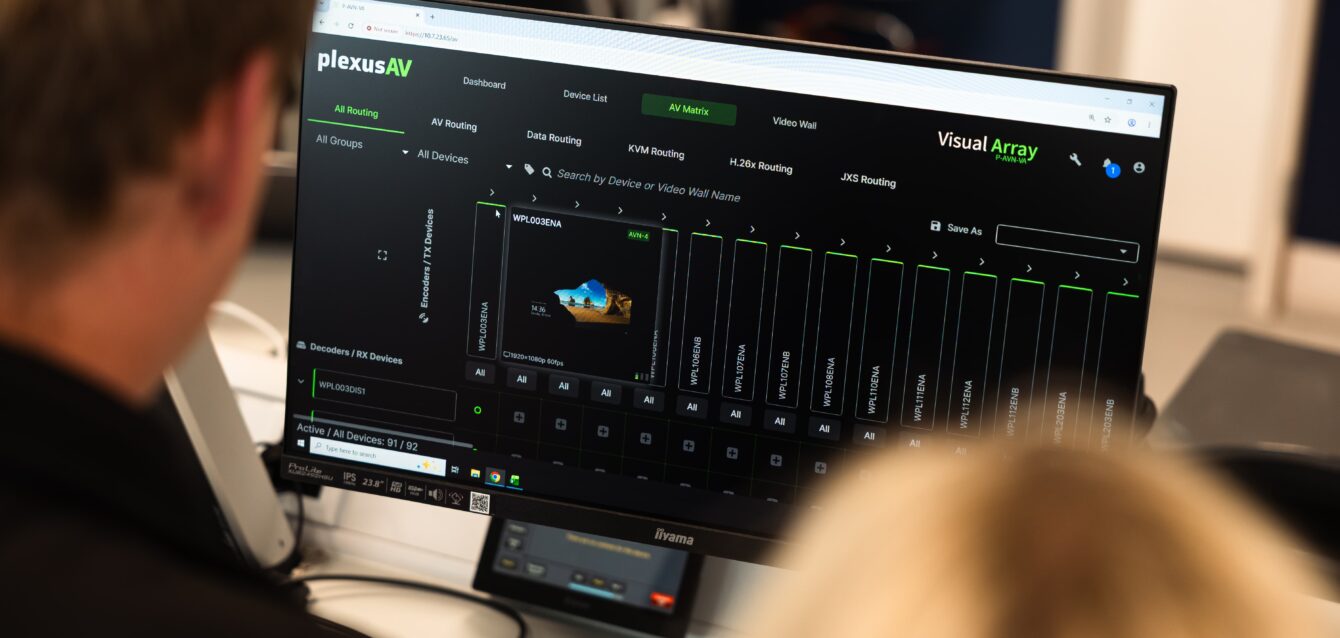
As one of the UK’s leading universities for engineering, science and technology, Loughborough University continually invests in facilities that enhance teaching, research and the student experience.
Opened following a £17 million investment in 2017, the university’s STEM Labs were designed to provide highly flexible laboratories, workshops and collaborative teaching spaces capable of supporting modern engineering education.
As teaching requirements evolved, however, the university recognized that its decade-old AV infrastructure no longer delivered the flexibility, reliability and scalability needed to support increasingly connected learning environments.
Working collaboratively with GVAV, onemedia und PlexusAV, Loughborough University implemented an open AV-over-IP platform that now enables content to be shared seamlessly across the STEM Labs while providing a future-proof foundation for years of continued innovation.

The Challenge
Although the STEM Labs were purpose-built for collaborative teaching, the university’s existing AV infrastructure had become increasingly restrictive. Fixed point-to-point connections limited flexibility between spaces, while aging equipment resulted in higher maintenance requirements and reduced operational efficiency.
Teaching spaces increasingly needed to support multiple teaching styles – from traditional lectures and demonstrations to collaborative group work and practical laboratory sessions – yet sharing content between rooms and technologies was not always straightforward.
At the same time, expectations from both staff and students had changed significantly. The university wanted technology that was intuitive, connected and adaptable, allowing academics to focus on teaching rather than operating complex AV systems.
“Technology is the key enabler for us. It’s all about supporting the academics’ need for flexibility – presenting in different ways in a seamless, engaging and inclusive environment.”
Designing a Flexible Platform for the Future
Rather than simply replacing existing hardware, the university wanted to create an AV infrastructure capable of evolving alongside future teaching requirements.
Key objectives included flexible content routing throughout the STEM Labs, open standards rather than proprietary technologies, real-time monitoring and management, greater operational reliability, simplified support and maintenance and a scalable platform capable of future expansion.
Equally important was selecting partners who understood higher education environments.
Consultation played a central role throughout the project, with Loughborough University working closely alongside GVAV, onemedia and PlexusAV to evaluate different technology options through workshops, proof-of-concept testing and collaborative design sessions. Solutions including HDBaseT and Dante were assessed before the team selected PlexusAV’s AV-over-IP platform, providing the flexibility, openness and long-term scalability required.
“The project was never simply about selecting products. It was about understanding exactly how Loughborough University wanted to use its teaching spaces, both today and in the future. Through workshops, proof-of-concept testing and close collaboration with the university, GVAV and PlexusAV, we were able to design a solution that not only met the immediate requirements but also provides a clear roadmap for future expansion as teaching needs continue to evolve.”
Jon Jeffreys, Sales & Marketing Director at onemedia
“The first step was understanding how the university actually uses its learning spaces day to day. It was important that the infrastructure was built around open standards, giving the university greater visibility, flexibility and reliability while providing a platform that could continue to evolve without requiring major redesign.”
Delivering Connected Teaching Spaces
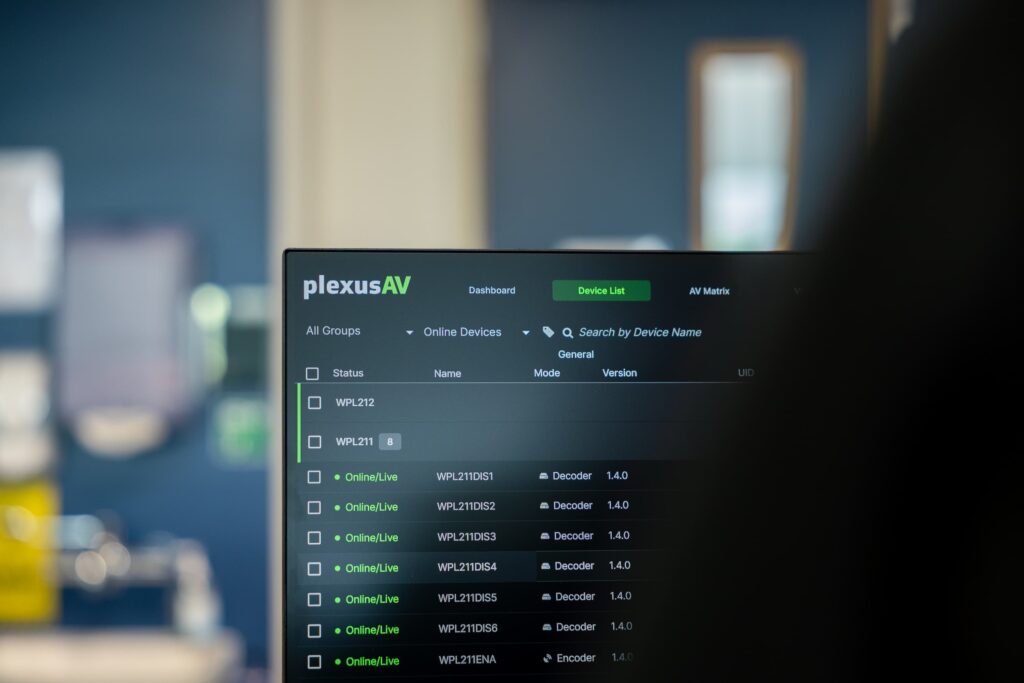
The completed deployment incorporates 93 PlexusAV P-AVN-4 transceivers alongside the Visual Array Management Platform (VAMP).
Unlike traditional point-to-point infrastructure, the AV-over-IP platform enables teaching spaces across the STEM Labs to operate as one connected environment.
Content can now be routed between rooms without being restricted by fixed AV architecture, creating what Arthur Brockhoff, European Sales Manager at PlexusAV, describes as a “virtual matrix.”
“By moving to an open AV-over-IP platform, Loughborough University now has a virtual matrix that allows content to move freely between teaching spaces rather than being confined to individual rooms,” Arthur said. “That flexibility, together with support for multiple codecs and open standards, gives the university an infrastructure that is ready to adapt as teaching continues to evolve.”
Arthur Brockhoff, EMEA Sales Manager at plexusAV
Built around open standards, the system supports multiple codecs including H.264, H.265 and IPMX while integrating with existing network infrastructure, allowing the university to expand without extensive redesign or unnecessary hardware replacement.
The use of PlexusAV transcoders also protected previous technology investments by enabling existing equipment to remain in service wherever appropriate.
“During the design workshops, we identified bandwidth constraints across parts of the existing network. Thanks to the P-AVN-4’s ability to deliver both ultra-low compression streams over a 1Gb network, we could use high compression to link multiple teaching spaces together, while low-compression JPXS streams provided ultra-low latency within individual rooms. That flexibility meant Loughborough University could maximize its existing network infrastructure while creating a scalable AV-over-IP platform ready for future expansion.
Scott Pollard, Regional Sales Manager UK – Ireland & Nordics at plexusAV

Sustainability Build Into the Design
Sustainability was another important consideration throughout the project. With universities facing increasing pressure to reduce energy consumption, the selected platform needed to support Loughborough University’s wider environmental objectives.
PlexusAV’s Eco Mode enables transceivers to automatically reduce power consumption when not actively streaming, lowering electricity usage across the AV estate while allowing devices to be remotely reactivated via API when required.
Across a large deployment, these efficiencies deliver significant operational and environmental benefits, helping the university reduce energy consumption, lower running costs and support its longterm sustainability ambitions.
For Loughborough University, those efficiencies translate into measurable long-term benefits. Operating continuously, each PlexusAV P-AVN-4 transceiver consumes just 26W during normal operation, reducing to 14.8W when Eco Mode is enabled outside teaching hours, including evenings, weekends and holiday periods.
Across the deployment of 93 devices, this intelligent power management delivers an estimated 40% reduction in energy consumption and annual operating costs. Over five years, enabling Eco Mode is projected to save approximately 42,664 kWh of electricity, reduce energy costs by around £10,960, and prevent an estimated 8.83 tonnes of CO2 emissions.
This demonstrates how smart AV infrastructure can support both operational efficiency and the university’s wider sustainability objectives.

Solution At a Glance
For Aaron Turlington-Smith, the project has delivered exactly what the university set out to achieve. The new AV-over-IP platform has created consistent, connected teaching spaces that can evolve alongside changing educational requirements.
The ability to route content freely, monitor devices centrally and expand without significant infrastructure changes provides confidence that the STEM Labs will continue supporting teaching and learning well into the future.
“The biggest improvement has been flexibility. We’re no longer constrained by individual teaching spaces and can easily route content around the building. The technology is much less of a barrier now, allowing staff to focus on teaching and students to focus on learning.”
Scott Meikle, Technical Project Manager at GVAV
If you are interested on working on a similar project and would like to learn more about how PlexusAV can fit into it, please reach out at sales@plexusav.com
